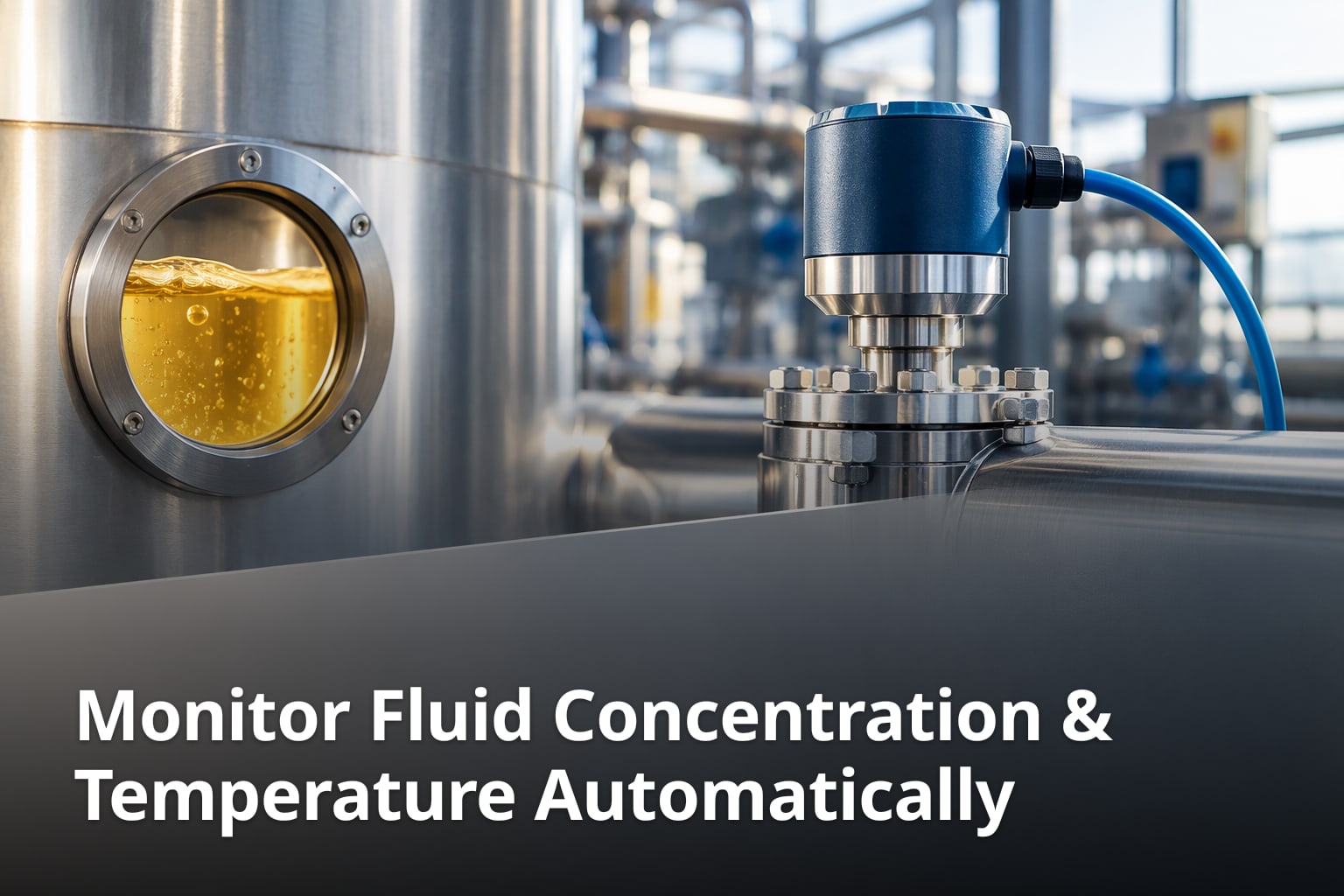
Monitor Fluid Concentration & Temperature Automatically
How automatic monitoring of process fluid concentration and temperature works, and how alerts, installation, dosing and integration fit together.
- What is process fluid concentration monitoring?
- Why is automatic monitoring important for process fluids?
- How does sensor-based fluid monitoring work?
- What are the benefits of using Digiclean for fluid monitoring?
- How can real-time alerts improve fluid management?
- How easy is it to install a fluid monitoring system?
- What role does dosing play in fluid monitoring?
- Can fluid monitoring systems integrate with existing workflows?
In many plants, a wash bath is checked by taking a sample, running a titration and adjusting the dosing by hand. Between two samples nobody sees how the bath is changing, and limited concentration data can lead to overdosing and premature bath changes, which raises operating costs. Automatic monitoring replaces the periodic check with a sensor in the tank that measures concentration and temperature continuously, giving plant teams visibility and control over their process fluids.
What is process fluid concentration monitoring?
Process fluid concentration monitoring means measuring how much active chemistry a bath contains, together with its temperature, so that you know whether the bath is inside its operating window.
- Concentration shows how much of the chemistry is actually in the bath.
- Temperature is tracked alongside it, because both influence quality, process stability and efficiency.
- Continuous readings replace the single snapshot a manual sample gives.
- Alerts tell the team when a value moves outside the operating range.
Process fluids is the umbrella term for the liquids that do the work in a production process, for example wash baths for technical cleanliness, pretreatment baths and machining fluids. In parts washing the condition of the bath is directly linked to how clean the components are, which is why technical cleanliness teams pay close attention to it.
Digiclean's website lists surface treatment, technical cleanliness, machining fluids and pretreatment as typical applications. Which fluids and measurements fit depends on the process, so the practical way to establish fit is a process review of the tanks in question.
Why is automatic monitoring important for process fluids?
A manual sample only shows the bath at the moment it was taken, while continuous monitoring shows how the bath develops between samples. That difference is what lets a team move from controlling by samples to controlling by trends.
- Less manual sampling and less operator handling of chemicals.
- Alerts when concentration moves outside the operating range.
- Dosing based on real process conditions instead of habit.
- Centralised process data that supports traceability.
Manual sampling and manual dosing increase workload and leave more room for process variability. Unstable fluid conditions can cause quality issues, rework and production downtime. When concentration data is limited, plants tend to dose extra to be on the safe side and to change baths by the calendar rather than by their actual condition, which sends usable solution to waste treatment and means paying again for chemistry, water and downtime.
Continuous data also gives quality teams something to point to. Access to centralised process data across tanks and production lines supports traceability, which matters as cleanliness requirements tighten and tolerances narrow. Monitoring does not replace every quality test or inspection. What it does is make the conditions behind the result visible, so the team can control the process that creates the result instead of only inspecting the result afterwards.
The same data helps environment and sustainability teams. Using less chemistry and fewer bath changes means less chemical waste and wastewater, which is why better process control and environmental results tend to go together.
Different roles look at the same data for different reasons. Operations teams value control, quality teams value evidence and environment teams value measurability. Process fluid data sits at the centre of all three, which is why one set of continuous readings can serve a production manager, a technical cleanliness specialist and a sustainability manager at the same time.
A useful test for any bath is to ask how often it is sampled and what happens between the samples. Staying within limits at the last sample is not the same as being stable. If the honest answer is that nobody knows until the next sample, the bath is a candidate for continuous monitoring.
How does sensor-based fluid monitoring work?
A sensor installed in the tank continuously measures the chemical concentration and temperature of the fluid, and a platform turns those readings into operational visibility, alerts and dosing.
Digiclean describes its system in four parts. The sensor continuously measures chemical concentration and temperature. The Digiclean platform transforms real-time process data into visibility, alerts and automated chemical dosing. Operators monitor process conditions, respond to deviations or automate dosing through one centralised platform. The result is a more stable process, optimised chemical consumption and better traceability. The sensor communicates wirelessly, and the platform shows both current and historical data.
Before the readings can be trusted, the system has to learn the tank. During a start-up phase, sensor data is compared with the plant's own reference measurements, such as titration results, and machine learning trains a model for that specific tank. The model then predicts the same values, in the same units, that the team already uses. Manual sampling continues during start-up, so the team can compare the predictions with its own results sample by sample and build trust on its own data, in its own bath.
Once the model is running, the platform can show real-time predictions alongside temperature, calculate dosing needs, document readings and actions digitally and raise alarms before the bath leaves its operating window.
- A sensor in the tank measures concentration and temperature.
- Wireless communication carries the readings to the platform.
- Current and historical data are shown in the platform, which also sends alerts.
- An API connects it to MES, ERP and SCADA systems.
What are the benefits of using Digiclean for fluid monitoring?
Digiclean combines a plug-and-play sensor with a platform for visibility, alerts and intelligent dosing, and, according to its website, installation takes less than two hours without production downtime.
The installation approach is the first practical benefit. Digiclean states that the system is installed in less than two hours, with no production downtime and no modifications to existing systems. For a plant team, that means a monitoring project does not have to wait for a planned shutdown.
The second benefit is day-to-day work. Customer feedback published on Digiclean's website describes a switch from weekly or daily measurements to continuous monitoring of key parameters, less handling and longer bath life, and results and calculations in real time with more detail than before.
Digiclean's Parker Hannifin case study describes how Parker gained real-time visibility into its process fluids, reduced chemical usage and improved operational control through continuous monitoring and data-driven decision making.
Environmental impact is part of the picture. Digiclean publishes figures for wastewater, chemical and CO2 reductions on its website, and its Parker Hannifin case study links better process control to reduced chemical consumption, wastewater and CO2 emissions. Treat those figures as published results from specific customer cases rather than a promise for every plant, because the outcome depends on the bath, the process and the starting point.
Digiclean is designed to scale from a single tank or production line to multiple processes and facilities, so a team can start small and expand as its needs evolve.
- Installation in less than two hours, without production downtime or modifications to existing systems.
- Real-time visibility of chemical concentration and temperature.
- Alerts and intelligent dosing from the same platform.
- API integration with MES, ERP and SCADA systems.
- Scales from one tank to multiple processes and facilities.
How can real-time alerts improve fluid management?
Real-time alerts tell the team when chemical concentration moves outside the operating range, so they can act before the deviation reaches production.
1. Define the operating window.
Agree with the process and quality teams which concentration and temperature range the bath should stay in. An alert is only as useful as the window behind it, so write the limits down and keep them with the process documentation.
2. Decide who responds.
Name the person or role who receives an alert and what they check first, for example whether the bath needs dosing or a verification sample. Knowledge of how a bath behaves often sits with one or two experienced people, and a clear response plan means control does not leave with them on holiday.
3. Compare predictions with your own samples.
During start-up, keep taking your usual samples and compare them with the readings. When the two agree sample after sample, the team has evidence from its own bath that it can trust the sensor.
4. Review the trend, not only the alarm.
Use the historical view to see how the bath behaves over time. Trends show drift early and support the decision to change a bath based on its actual condition instead of the calendar.
- Alerts follow a window the team has defined.
- Someone owns the response.
- Early samples build trust in the readings.
- Trends support condition-based bath changes.
How easy is it to install a fluid monitoring system?
With Digiclean, installation is plug-and-play and takes less than two hours, without production downtime or modifications to existing equipment, according to the company's website.
1. Review your process.
Digiclean starts by understanding your process fluids and operational goals, usually through a process review with its team.
2. Select the tanks.
Together you identify the process tanks where monitoring will deliver the greatest operational value.
3. Install the sensor.
During the start-up meeting you jointly identify the best location for the sensor and define the installation plan. Because the system is plug-and-play, there is no need for construction work or equipment changes, and installation is designed to be completed without interrupting production.
4. Start optimising.
After installation you can monitor, control and improve the process. Digiclean states that most customers begin gaining visibility into their process fluids immediately after installation, and that operational improvements typically become visible during the first weeks of monitoring.
To get the most from the process review, it helps to bring a short list: the tanks in scope, how often each one is sampled today, how the bath is changed, and who in the plant is responsible for it. That gives the discussion a factual starting point and makes it easier to pick the first tank.
On the commercial side, the published options are to purchase the hardware or to choose a monthly licence that includes the hardware and service.
- Plug-and-play installation in less than two hours.
- No production stop and no modifications to existing equipment.
- The sensor location is agreed at the start-up meeting.
- Hardware purchase or monthly licence including hardware and service.
What role does dosing play in fluid monitoring?
Dosing brings the bath back inside its operating window by adding chemistry when the bath needs it and in the amount it needs.
Monitoring tells you what the bath is doing, and dosing is the action that follows. In Digiclean's platform, dosing needs are calculated from the readings, and operators can follow them manually or automate dosing, all in one centralised platform. Automated dosing adds chemicals only when the bath needs them, instead of a little extra just in case.
The reason this matters is cost and waste. Limited concentration data can lead to overdosing and premature bath changes, and both increase operating costs. Optimising chemical usage based on real process conditions is one of the ways Digiclean aims to reduce chemical consumption.
Dosing also affects the people around the bath. Frequent sampling and manual chemical dosing increase operator handling and exposure, so reducing both is part of the safety case for automation.
- Dosing follows measured concentration, not habit.
- Operators can dose manually or automate dosing.
- Less over-dosing can mean less chemical consumption and waste.
- Less manual handling for operators.
Can fluid monitoring systems integrate with existing workflows?
Digiclean can be integrated with existing MES, SCADA, ERP and other operational systems through API connections, so that process fluid data can sit in the platforms the plant already uses.
The technical connection is only part of the job. Decide which system should receive alerts, who owns the response and which dosing actions may run automatically. A short physical installation does not replace that planning, and agreeing it early is what turns the data into daily decisions.
For quality teams, centralised process data across operations and production lines supports traceability, because every reading and action is documented digitally.
- API connections to MES, SCADA, ERP and other systems.
- Process fluid data centralised in one platform.
- Alerts and dosing responsibilities agreed before go-live.
- Digital documentation supports traceability.
Related reading: Join us in shaping the future of industrial.
What types of process fluids can be monitored?
A wide range of industrial process fluids can be monitored, and the specific fluids and applications depend on your process requirements. The website lists surface treatment, technical cleanliness, machining fluids and pretreatment as applications. Fit is best established in a process review rather than assumed.
How long does installation take?
Installation typically takes less than two hours and does not require modifications to the production environment. It is designed to be completed without interrupting production, and the sensor location is agreed at the start-up meeting.
Which measurements does the platform show?
Real-time visibility is currently provided for key process parameters such as chemical concentration and temperature. If you need additional measurements, the team can help evaluate your specific requirements.
How does the system learn a specific tank?
During a start-up phase the sensor data is compared with the plant's own reference measurements, such as titration results, and machine learning trains a model for that tank. Manual sampling continues during start-up so the team can compare the predictions with its own results.
Can the data be used in our existing systems?
Yes, through API connections to MES, SCADA, ERP and other operational systems, so process fluid data can be centralised in the platforms you already use.
Do we purchase or licence the sensor?
Both options are available. You can purchase the hardware, or choose a monthly licence that includes the hardware and service.
How quickly can we start seeing results?
Most customers begin gaining visibility into their process fluids immediately after installation, and operational improvements typically become visible during the first weeks of monitoring.